Gabriele D’Annunzio
M: Son of the CenturyGabriele D’Annunzio is presented as Italy’s foremost poet and a celebrated soldier whose international literary fame and wartime exploits made him a living legend. His importance in the postwar political story lies in his ability to fuse poetry, military action, and mass spectacle: he gives national grievance a compelling public language, makes Fiume a model for political renewal, and supplies imagery that Benito Mussolini later adapts. Yet symbolic authority does not translate reliably into political control. By the 1922 crisis, Mussolini courts D’Annunzio’s prestige while judging him ineffective; after the murder of Giacomo Matteotti, D’Annunzio condemns the country’s moral condition but has turned toward literature rather than renewed political adventure.
Poet, Soldier, and Public Symbol
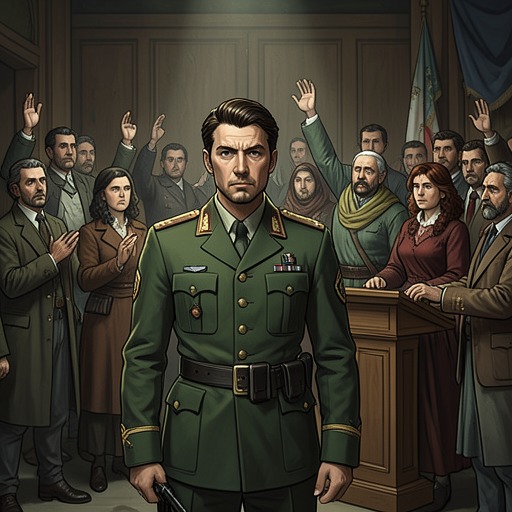
D’Annunzio’s standing rests on the unusual conjunction of literary renown and military reputation. He served as a soldier, sailor, and aviator, and the narrative treats him as a figure able to carry the poet’s authority from cultural salons into public squares. His war record, aesthetic persona, and reputation among veterans gave him a public presence beyond that of an ordinary political speaker. He could appear at once as a celebrated author and as a man who had acted in the conflict he described.
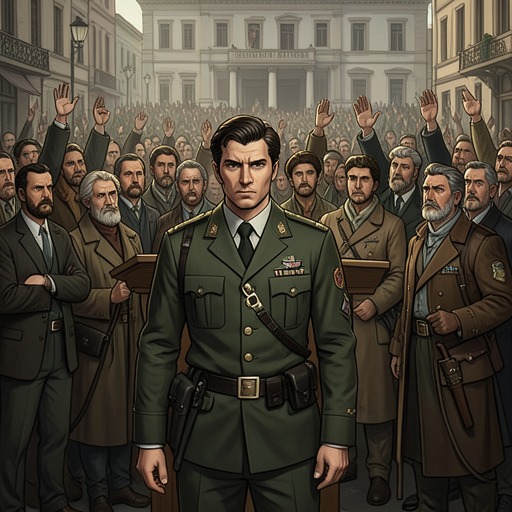
The scale of that authority is visible in Rome, where tens of thousands gather in Piazza del Campidoglio waiting for him to appear at the city hall balcony. The crowd is largely young and physically sound, yet his language of the mutilated victory makes some twenty thousand of them feel deprived of something essential. The phrase converts a diplomatic and national grievance into a personal sensation of loss, and the crowd’s admiration shows how effectively D’Annunzio’s poetic image can organize political feeling. His performance aims at a further fusion: the people and their leader joined in a single public scene.
His postwar outlook belongs to a wider atmosphere of distrust toward established politicians and renewed attention to the returning soldiers. The narrative describes Europe as a stage emptied of its old political actors and emphasizes the mass of veterans pressing back into public life. In that setting, D’Annunzio’s prestige among former combatants made him a natural focus for those seeking a politics of youth, action, and national renewal. His appeal was not simply a matter of fame: it connected the experience of war to a promise that national life could be remade.
Fiume as Political Experiment and Spectacle
When D’Annunzio’s troops entered Fiume shortly after eleven in the morning, the population welcomed them in a scene of public celebration. The episode established a political stage on which the poet could appear not only as a national symbol but as the leader of an actual movement. Fiume became the setting for his attempt to give a new political order both a dramatic form and an ideological program.
In a speech about Italy and life, he first argues for Fiume’s Italian identity and carefully sets out the territorial boundaries he believes a free Italian nation should possess. The address then moves beyond the immediate territorial claim. Fiume becomes, in his vision, a beacon whose meaning reaches beyond the city and a place defined by life rather than sacrifice. This change of emphasis gives his project two registers: it remains an assertion of Italian national claims, yet it also presents Fiume as a source of wider renewal. The city’s significance thus depends both on its disputed political status and on the symbolic future D’Annunzio assigns to it.
That future acquires a constitutional dimension when Alceste De Ambris delivers a draft charter to D’Annunzio on March 18, 1920. De Ambris, whom D’Annunzio had called to lead his cabinet, prepared a text influenced by radical socialism and libertarian principles. Its proposed democracy centers the rights of workers and individuals. The draft complicates any simple description of Fiume as a purely nationalist project: under D’Annunzio’s leadership, the city’s political experiment also draws on demands for social and individual rights. The narrative places the charter’s advanced aspirations beside the armed presence of the legionnaires, holding political innovation and military power in the same frame.
Fiume also becomes a possible base for intervention in Italy. In a plan sent near the end of September, D’Annunzio proposes restoring a new order by drawing together the country’s supposedly healthy energies, with himself as the organizing figure. He wants this intervention to proceed on the basis of Fiume’s constitution and imagines the city as capable of redeeming Italy. The plan shows that he does not regard Fiume as a self-contained episode: he seeks to turn its political experiment into a national alternative, with himself at its center.
Ambition, Appropriation, and Rivalry
D’Annunzio’s ambition to lead a movement in Italy intersects with Mussolini’s developing strategy. In October 1922, Mussolini tells his associates that the negotiations he is conducting with Luigi Facta are a diversion and that the moment for a march on Rome has arrived. He says he has recently met D’Annunzio at Gardone and reached an understanding with him for the time being. He also describes a possible public reconciliation between Giovanni Giolitti and D’Annunzio, to be staged at the Tomb of the Unknown Soldier on November 4. The proposed ceremony would place political reconciliation amid the commemoration of victory and the presence of wounded and former soldiers.
Mussolini’s assessment of D’Annunzio is more guarded than his willingness to seek his support. He recognizes the poet’s appeal even among Fascists, but regards him as politically ineffective: a man capable of making a grand advance without leaving a durable political result. This distinction helps explain the relationship between them. D’Annunzio possesses symbolic capital that Mussolini wants to draw upon, while Mussolini is building an organized political force whose decisions do not depend on the poet’s leadership.
D’Annunzio, meanwhile, sees Mussolini’s approach as an appropriation of ideas and symbols associated with his earlier project. After years in which the poet had conceived a march on Rome, Mussolini’s personal secretary arrives on October 24 to propose that D’Annunzio join Mussolini’s march. D’Annunzio has also received overtures from Luigi Facta, and proposals for a government involving Francesco Saverio Nitti and Vittorio Emanuele Orlando. These competing approaches place him at the center of attempts to enlist his prestige, but they do not establish that he has command over the forces seeking his endorsement.
His position remains unsettled. During an illness, he tells a friend that he cannot promise to travel to Rome, and his doctor advises him to remain silent and rest. On the afternoon of October 25, however, he directs that newspapers be informed of an abrupt improvement. The narrative sets this announcement beside reports of Mussolini’s triumph in Naples, emphasizing the political pressure surrounding D’Annunzio’s possible return to public action without resolving what he would ultimately do. His earlier Fiume project remains a point of comparison, but the immediate contest is increasingly controlled by others.
Retreat, Legacy, and Narrative Role
D’Annunzio’s later political position is marked by the gap between the expectations attached to his name and his limited participation. In 1924 he is still alive at Lake Garda, and veterans, including wounded and disabled former soldiers, look to him as a natural leader. Yet he has decided to devote himself to literature. The state’s purchase of his manuscripts provides the material circumstance accompanying that withdrawal, while the veterans’ continued regard shows that his symbolic standing has not simply disappeared.
After Matteotti’s murder, D’Annunzio speaks from Gardone against the Italy implicated in the killing, describing it as morally ruined. The condemnation is significant because it comes from a figure once associated with a politics of national rebirth and public action. But his words do not become a new political venture: by this point, the narrative presents him as having left adventure behind. The contrast is stark. Those looking for a leader still turn toward his name, while the man himself has chosen literary work over a return to the political arena.
The narrative’s portrait therefore resists treating D’Annunzio either as a mere precursor to Mussolini or as a political leader who could direct the forces he helped inspire. His speeches and Fiume project make him a powerful maker of political symbols: the wounded nation, the young crowd, the city of life, the new order. Mussolini can borrow from this repertoire and court its author, but also judge that D’Annunzio cannot convert his appeal into sustained political command. The resulting tension gives D’Annunzio’s arc its defining shape: he remains an immense presence in the imagination of the period even as the organized movement he hoped to influence proceeds without him.